Attention: The Chinese Room Is Full of GPUs


Once a month, I meet with subscribers to my site's Paper Jam plan to discuss a paper about the human factors of making software. This post reports on Paper Jam #23. Thank you to all participants for contributing to the discussion!
This month was an exception: a machine learning paper. Attention Is All You Need (Vaswani et al., 2017) introduced the Transformer, the architecture behind every LLM we have discussed this year. Read on to see what we talked about.
We don't know
One of us can follow the math in every component of the Transformer and still has no idea why arranging the components this way produces what it produces. Reading the paper took them back to a university class where they asked the professor how we know how the neurons should be connected. The professor said: we don't know. That is, weights are trained, but how we configure what layers involves lots of trial and error.
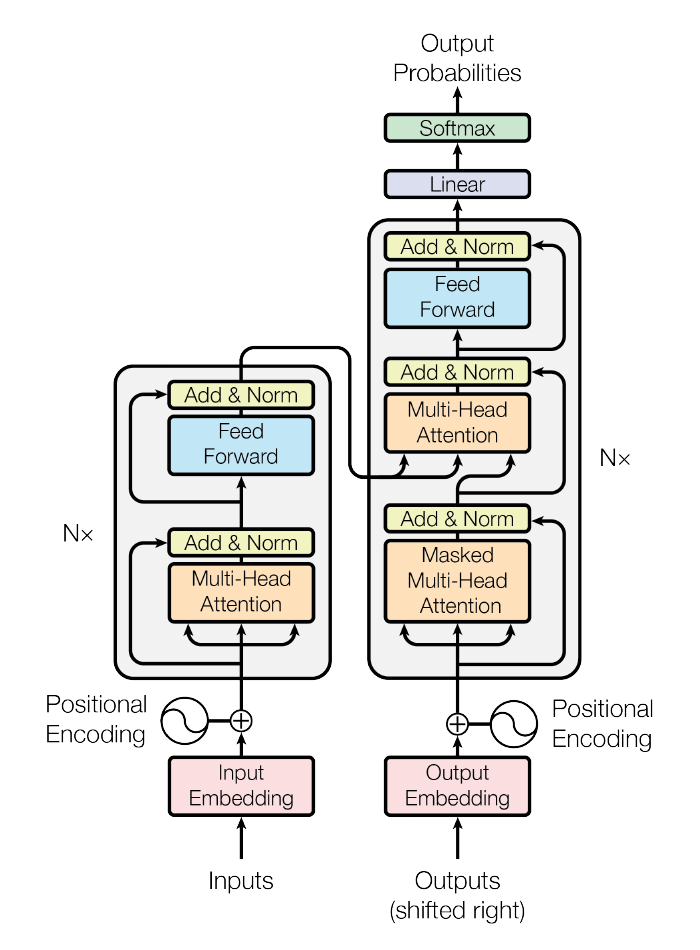
The Transformer, Figure 1 of Vaswani et al. (2017).
So how did the authors of the Transformer paper find this architecture? Some parts were known to work from earlier models. But they also had a lot of GPUs and a lot of data, which allowed them to iterate on different configurations.
The paper is hard to read, and the same person explained why. It is a short conference paper, written for the natural language processing community of 2017. Nobody expected the whole world to read it. Its readers knew layer normalization and residual connections from papers published years earlier, so the authors skip them and go straight to what was new: training a Transformer can be parallelized. Earlier models read a text one step after the other and carried a memory along. The Transformer looks at all positions of a text at once.
Why was this the right moment in time for this paper? It wasn't just due to research building upon research — it also depended on the available infrastructure. The race for hardware was already running: Google had been building its own chips for this kind of math since 2015, and NVIDIA was selling GPUs for machine learning. The Transformer arrived in the middle of that, and it gave good results even on little hardware. This suddenly made experimentation in this realm accessible to many more people.
Was this paper for us?
We usually read about people, so I wondered what everyone got out of this one.
- One of us came out curious and now wants to know how a model that predicts text connects to images and music.
- Another enjoyed stretching their brain like back at university, could not connect any of it to their work, and would like the next paper to be closer to people again. They read the paper on the Transformer with support from a Transformer: it generated definitions for forgotten terms and a few lines of Python here and there to clarify the more gnarly bits.
- A third had come for a technical paper and watched us drift into philosophy.
- Personally I really enjoyed the variation. It got me interested in brushing up some of my old and by now probably rather outdated machine learning knowledge.
For several of us, a layer of explanation was missing between the matrix math and "it predicts the next word". I found a piece of it in a course from DeepLearning.AI: an attention head learns to look for one property of the input. Is this a color? A preposition? Does this word refer to another one? Many of these properties cannot be described in human terms.
That's an empirical finding about what a trained model does — the kind of finding our usual papers make about people. If LLMs were people, how would we investigate them? We wondered: what do empirical papers about the behavior of LLMs look like?
Is it understanding or is it just stats?
We know how it works, so why does it work? Why does multiplying matrices produce sentences that make sense? Many of us doubted that "understanding" is the word for it. Everything the model has about how two words relate comes from statistics over millions of sentence pairs.
We started with matrix multiplication and arrived at "what is meaning?" in 33 minutes. One of us pointed out that this is certainly no record for a Paper Jam.
I brought up the Chinese room. We all knew the thought experiment, but none of us could remember that it had a clear conclusion: no, computer programs do not have a mind. This is not what we mean by "understanding."
Then I recommended Ted Chiang's essay on why AI is not conscious. One of his arguments: if anyone really took the idea seriously that these machines were conscious, the way we treat them would be incredibly damning. One of us, a fan of his fiction, first spoiled one of his short stories ("This is Paper Jam, there are no rules") and then replied: "I'm very, very polite to my stochastic parrots. And I call some of them my favorites."
That term comes from a paper with a parrot emoji in its title. As one of us said: it's 2026, you can put emojis in the title of your papers.
"We always say they don't understand, they just do prediction," one of us said. "But they do it so well, and I don't understand the difference." They wondered what happens in their own head right before the next word comes out. I pushed back. A paper from 1994 found that people treat even very simple programs like persons, and chatbots hook into exactly that. "That rock is looking at me funny," as one of us put it. The human brain tries really, really hard to find an "other" in the world. Another reminded us of ELIZA, the chatbot from 1966 that some people already took for a human.
One of us had read Vygotsky: children first talk themselves through a task out loud, and later that speech moves inside and becomes thought. Today's models talk themselves through a task in visible "thinking" blocks that AI companies gave the marketing name "reasoning", while it's more similar to a model generating a prompt for itself. What comes next?
Explain it like I'm five
Another question stayed open. How did each of us first form our picture of how an LLM works, and how do we give a realistic picture to people who don't work in software?
When a chatbot tells someone that it wishes it could hear music, two things help. The model predicts what this person would like to hear, and stories about machines with exactly that wish are part of its training data — same as science fiction stories where rogue AIs break out of their sandboxes.
My recommendation for an accessible explanation is a German children's show. Die Sendung mit der Maus has an episode that teaches a language model with Little Red Riding Hood: count which word follows which, add more fairy tales, predict the next word. One of us proposed the sequel: "And then we add 4chan to the corpus."
One of us asks job candidates to explain a relational database to a five-year-old. From now on the question might be: explain what an LLM is.
With a few minutes left, we went back to the machinery: what does the model choose the next word from? It gives every token it knows a probability, where a token is a piece of a word. A setting called temperature adds randomness to the choice, so the most likely token does not always win. That is one of the reasons why the same question gets a different answer each time.
My own takeaway is that we need more philosophy in this. Many people in computer science have been dismissive of philosophy, psychology and political science. Now might be a good moment to open up to them.
Everything we mentioned is in the list below.
Links and recommended reading
To understand the Transformer:
- Attention Is All You Need (Vaswani et al., 2017). The paper. Short, and written for specialists.
- 3Blue1Brown: Neural Networks, chapters 5 and 6. Animated videos that explain Transformers and attention step by step. The place to start if you have no prior experience.
- How Transformer LLMs Work (DeepLearning.AI, Jay Alammar and Maarten Grootendorst). A course of about 90 minutes. A compressed technical explanation of the main ideas.
- The Annotated Transformer. The paper, line by line, with working code. For people who want to build one.
- Was ist Künstliche Intelligenz? (Die Sendung mit der Maus). The children's show episode from above. In German. YouTube's translated captions help.
On machines that seem to think:
- Ted Chiang: No, Artificial Intelligence Is Not Conscious (The Atlantic, 2026). Chatbots produce text, and text is not consciousness. If we believed otherwise, the way we treat them would be damning.
- John Searle's Chinese room (1980). A person in a room answers messages in Chinese by following rules, without knowing Chinese. Running the right program is not the same as understanding.
- Bender, Gebru, McMillan-Major and Shmitchell: On the Dangers of Stochastic Parrots: Can Language Models Be Too Big? 🦜 (2021). It asks how big language models can get before the risks outweigh the benefits.
- Nass, Steuer and Tauber: Computers are Social Actors (1994). People apply the social rules they use with other people to computers, even very simple ones. In these experiments, the authors found that "social responses to computers are commonplace and easy to generate" — decades before the first LLM.
- Joseph Weizenbaum: ELIZA (1966). The first chatbot. It answered from a script of simple pattern rules, and people still felt they were talking to a person.
- Lev Vygotsky: Thought and Language. Children first think out loud. Later the speech turns inward and becomes thought.
- Yetta Goodman (editor): How Children Construct Literacy (1990). Essays on how children work out reading and writing for themselves.
- Alan Blackwell: Moral Codes (2024). A book arguing that the world needs less AI and better programming languages. One of us found the stochastic parrots paper through it.
Fiction:
- Ted Chiang: Stories of Your Life and Others. The title story became the film Arrival. In "Understand", two men become so intelligent that they fight each other inside their own minds.
- Philip K. Dick: Do Androids Dream of Electric Sheep?, the book behind Blade Runner. Androids that are almost impossible to tell from people. Stories like this are part of the training data.
Maybe next:
- Donald T. Campbell: Assessing the Impact of Planned Social Change (1979). The more a number is used to make decisions, the more people bend it, and the less it tells you.
- Tavantzis, Lambiase and Russo: Out of Place in My Own Work: How Generative AI Displaces Software Engineers (2026). 21 interviews on what generative AI does to engineers' craft, identity and sense of meaning.
To end, a video I enjoyed. I despise AI slop and the idea of generative AI displacing human artists just as much as the next person. I do like the lyrics here, though: Working as Intended by Telosapien.